

The upside-down life of hanging parrots
How to defecate while hanging upside down without soiling your beautiful green plumage.

A while ago, I was reading a scientific article about climbing parrots when I stumbled across this sentence:
Moreover, parrots have extensive documented histories of […] adopting suspensory behaviors in other contexts (e.g. hanging parrots, who are unique among avians in choosing to sleep while suspended upside-down in a similar manner to roosting bats).1
“Wait—” I thought. “There are parrots that sleep while hanging upside down!?” I had no idea!
I did some research and soon learned that this behavior isn’t limited to sleeping. These birds from tropical southern Asia engage in a wide range of behaviors while hanging upside down: rain-bathing, feeding, preening, scratching, stretching, climbing, fighting—and, well, defecating (more on that below).
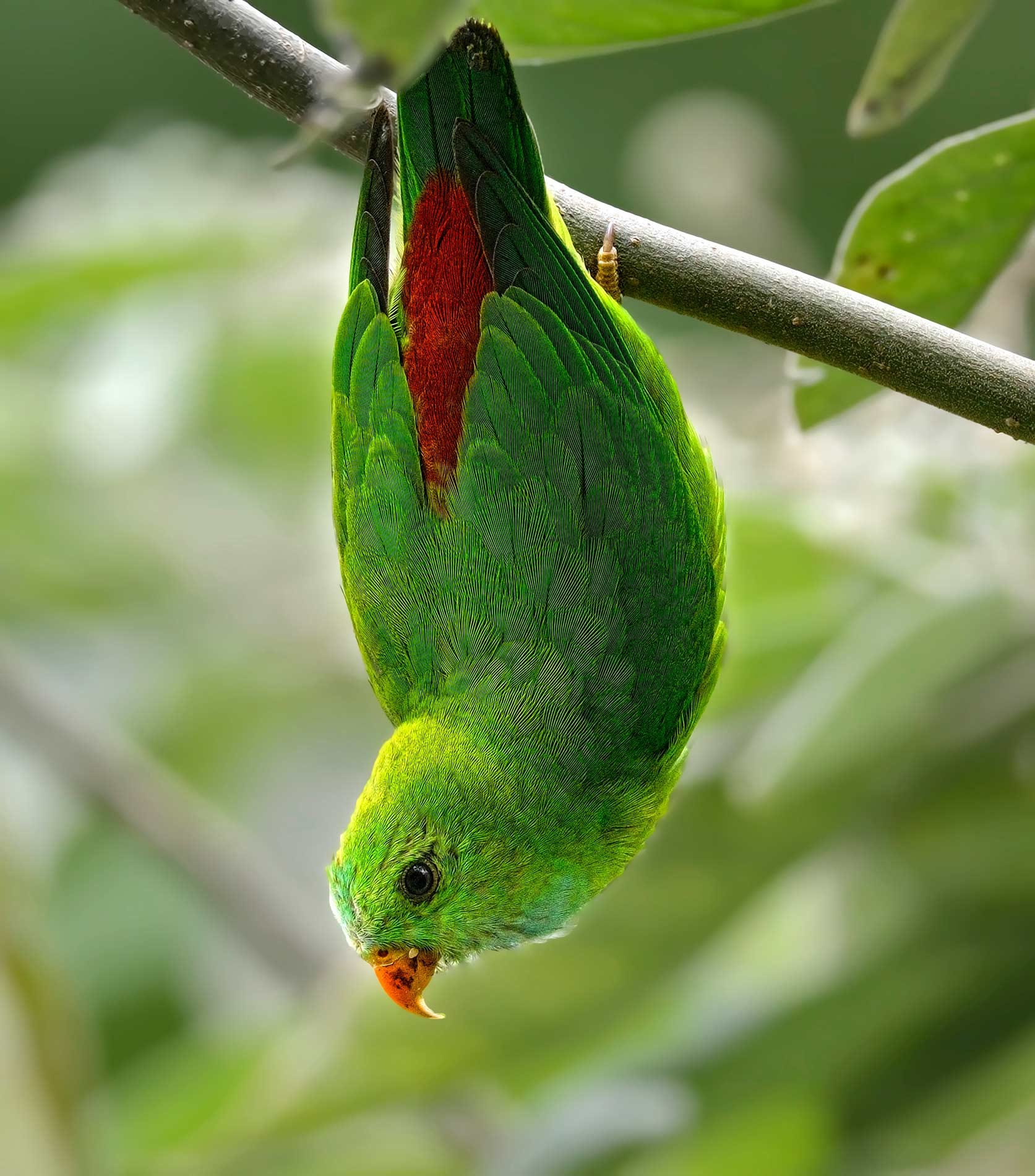
There are 15 described species of hanging parrots (genus Loriculus), all of them endemic to the tropical regions of southern Asia (and, sadly, all of them threatened by habitat loss due to deforestation). Their ability to sleep upside down has earned them the name “Fledermauspapageien” (“bat parrots”) in my native language (German), which I find absolutely adorable.
Why hang upside down? Sleeping in a hanging position improves their camouflage: with their green plumage and dangling posture, they resemble leaves. This position also helps them avoid predators while sleeping.
In 1968, Francine G. Buckley, a researcher from Cornell University, published a research paper2 on the behavior of two species of hanging parrots, the Blue-crowned hanging parrot (L. galgulus) and the Vernal hanging parrot (L. vernalis).
She reported that hanging upside down comes with challenges that aren’t immediately obvious. Regularly switching to a hanging position requires physiological adjustments, particularly to the circulatory system and the leg musculature. Because of these demands, very young and sick birds do not adopt a hanging position.
Another important challenge related to the upside-down life of hanging parrots is… defecation. As a hanging parrot, how do you relieve yourself while hanging upside down without soiling your beautiful green plumage? Buckley described how these birds manage to do that. To defecate, these parrots hang by only one foot and swing their body to a 45-degree angle relative to the perch. They raise their tail over their back to get it out of the way and then eject the feces away from their body using a strong contraction of the cloacal muscles. That’s exactly the kind of bird fact I love.
Hanging around in the canopy also has a social—and almost romantic—side. During courtship, males offer food to the female of their choice. And guess what? If the female accepts the food, the male is allowed to hang closer to her. 💚💚
Have a wonderful rest of the week! All the best,



Exactly my kind of bird fact, too!
Fascinating - I didn't know about these parrots either. And I think Fledermauspapageien is not the only German word which is elegantly informative. I was intrigued to come across 'Kurschatten' recently!