

Extreme climate events can change how birds sing
Birds sing differently after extreme climate events—and may no longer recognize members of their own species.

In 1977, the wet season brought only 24 mm of rainfall to the small island of Daphne Major. The Medium ground finches inhabiting this island in the Galápagos archipelago did not breed that year—they were struggling to survive. About 85% of the population died.
Extreme climate events, such as the 1977 drought, allow us to observe evolution in real time. On Daphne Major, only the Medium ground finches (Geospiza fortis) with beaks large and strong enough to crack the large, hard seeds that remained survived—and passed these traits on to future generations during subsequent breeding seasons.
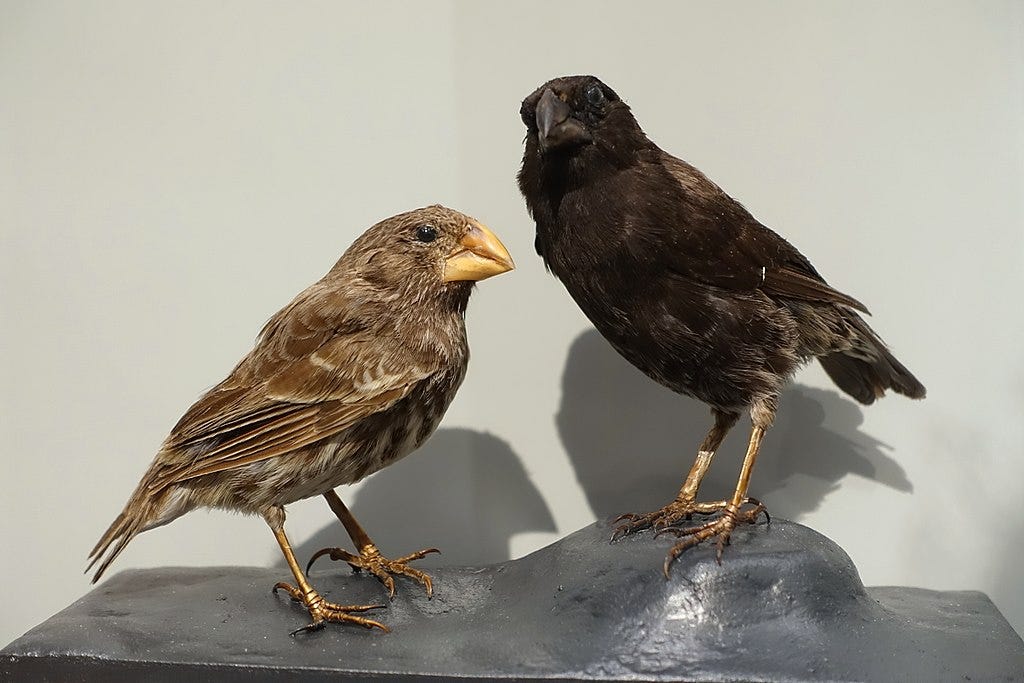
Let’s explore which unexpected consequences such changes of beak size in a bird population can have for the species.
First, it’s important to understand that having a larger, stronger beak doesn’t just affect what a bird can eat—it also affects how it sings. Previous research1 has shown that finches with big and more robust beaks tend to sing more slowly and with lower frequency ranges compared to finches with smaller, more delicate beaks.
A more recent study from 20242 found that drought-driven changes in beak shape can alter the song of Medium ground finches so dramatically that conspecifics from unaffected populations may no longer recognize them as members of their species!
Using existing knowledge about how droughts affect beaks and birdsong, the researchers simulated the beak shapes and calls of hypothetical future finches after varying numbers of drought events. They then played the calls of these future birds to male individuals in the wild to measure their response behavior—strong responses indicating that birds recognize the song as one of their own species.
The researchers observed that, despite the changes in song after three simulated droughts, the finches still responded aggressively, as if defending their territory. They often left their perch quickly to search for the perceived intruder.
However, after six simulated droughts, the songs had changed so much that the birds’ responses dropped significantly. They no longer recognized the song as one of their own species! Since these birds rely heavily on birdsong for mate choice, this would lead to reproductive isolation—and may drive the evolution of a new species!
The study was published in October 2024 in Science. You can read it here.
Have a wonderful rest of the week! All the best,



Thanks for bringing another fascinating piece of science to us. Drought influencing beak shape change, influencing song change, impacting breeding, and driving speciation - what a cool cascade of events!